
The Real Concern
When you upload your photos to an AI avatar app, it raises legitimate privacy questions. Your face is your most personal biometric data — once it is sent to a server, what happens to it? Is it stored permanently? Is it used to train the AI model? Could it be shared with third parties? These are the concerns every user should consider before using any AI avatar service.
These are not paranoid questions. In fact, the AI industry has seen numerous high-profile scandals where user data was repurposed without consent, used to train commercial models, or exposed in data breaches. For example, several popular apps faced backlash when users discovered their uploaded photos were being used to train facial recognition systems without explicit permission. Therefore, being cautious about where you upload your photos is not just reasonable — it is smart.
The key, however, is knowing what questions to ask and understanding the privacy practices of the services you use. Transparency is the most important signal of a trustworthy AI avatar platform. As a result, learning to evaluate privacy policies is an essential skill for anyone who cares about their digital identity.
Industry Standards
Privacy practices vary widely across AI avatar and image generation services, and understanding these differences is the first step toward protecting your data. Some platforms explicitly state that they use uploaded photos to train and improve their models. Others retain copies of user images for extended periods. A few even sell anonymized data to third parties. The following comparison shows how practices differ across key privacy dimensions:
| Privacy Practice | What It Means | Bobi's Approach |
|---|---|---|
| AI Training | Your photos used to improve the service's models | Never used for training |
| Data Retention | How long your original photos are stored | Originals deleted after generation |
| Third-Party Sharing | Your data shared with partners or advertisers | Originals never shared |
| User Deletion Rights | Can you request data removal? | Full deletion on request |
| Transparency | How clearly practices are communicated | Plain-language policy |
The industry is moving toward greater transparency, driven by both regulation and user demand. For instance, GDPR in Europe requires companies to disclose how they handle user data — and non-compliance can result in fines of up to 4% of global annual revenue. In 2024 alone, GDPR data protection fines exceeded €1.2 billion across the tech industry. However, compliance does not always mean alignment with user interests — the details matter.
When evaluating any AI avatar service, look for three things: clear, plain-language privacy policies; explicit statements about data usage for training; and transparent data retention and deletion practices. If a service cannot explain what it does with your photos in simple terms, that is a red flag. As a general rule, the more transparent a service is about its data practices, the more trustworthy it is likely to be.
What Bobi Does
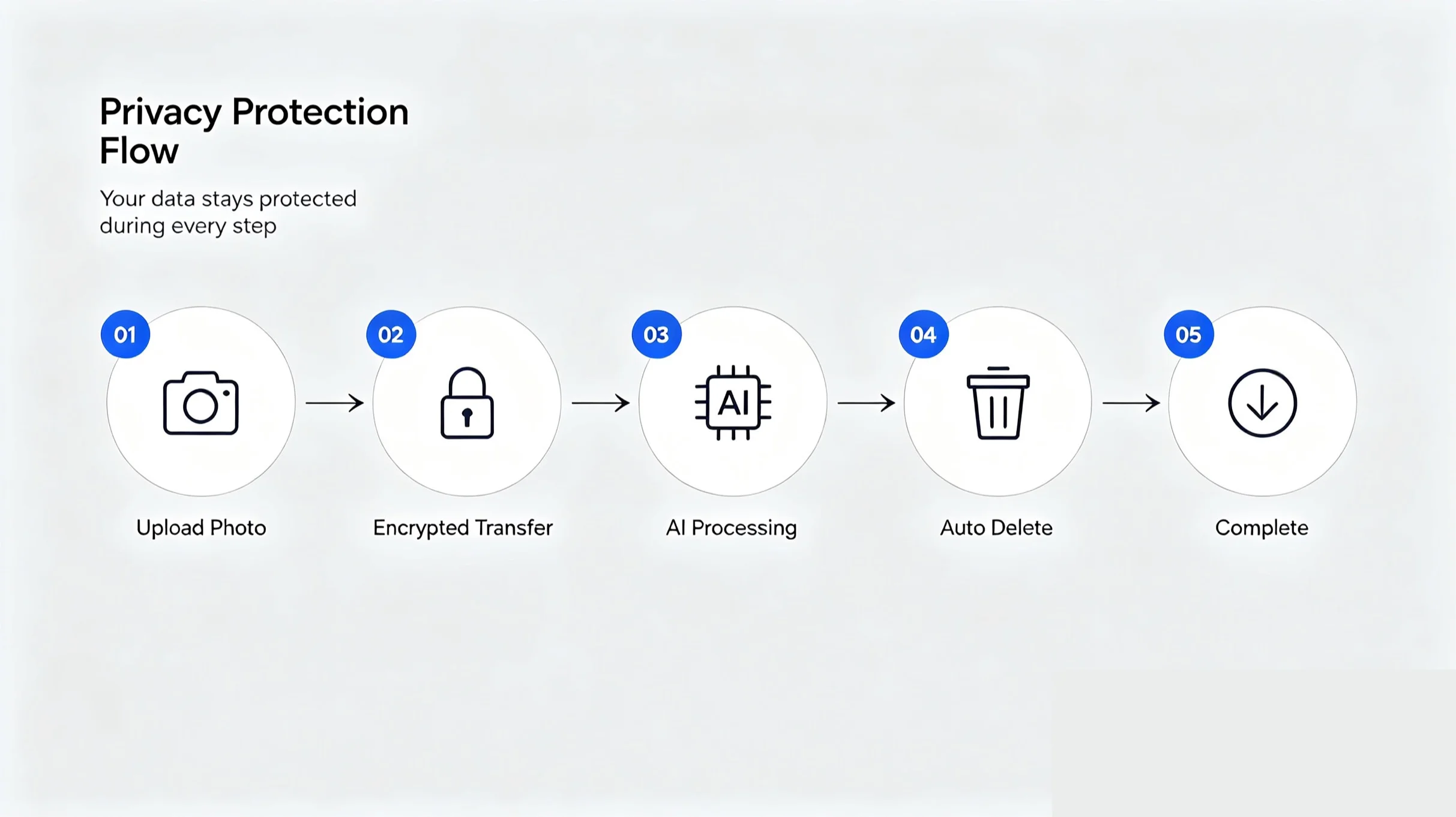
Bobi takes a straightforward approach to privacy: your photos are processed securely and are not used for AI training. The original images you upload are used solely to generate your stylized character portraits and are not retained beyond what is necessary for the generation process.
Bobi does not share your original photos with third parties. It does not use your uploaded images to train or improve its generative models. It does not store your original photos longer than needed for the service to function. Your data stays yours — full stop.
This approach reflects a simple principle: your face is your data. Bobi treats it with the same care and respect that you would expect from any service handling personal information. You should never have to choose between getting a great avatar and protecting your privacy.
How to Choose a Trustworthy Service
Beyond Bobi, if you are evaluating any AI service that processes your photos, here is a simple checklist to follow:
- 📋 Read the privacy policy — specifically the sections about data collection, storage, and sharing. If the language is vague or buried in legalese, consider that a warning sign.
- 🔍 Look for explicit statements about AI training. Does the service say it does not use your images for training? Or does it reserve the right to do so?
- 🗑️ Check whether the service offers data deletion — can you request that your uploaded photos be removed after generation?
- 🏢 Consider the company reputation and track record. Established companies with clear privacy practices are generally safer bets than unknown startups with opaque policies.
- ⚠️ Use your judgment: if a service is free, your data may be the product.
You Are in Control
Uploading your photo to an AI avatar service does not have to be a leap of faith. The best services — like Bobi — make their privacy practices clear and give you control over your data from start to finish.
You decide what to upload. You decide which style to use. You decide where to share the result. And when you are done, your original photos remain yours — unshared, untrained, and unstored beyond the generation process. In other words, you are never locked into a decision you cannot undo.
That is the standard every AI avatar service should meet. And that is the standard Bobi holds itself to — because your privacy should never be a trade-off for a great profile picture.
Frequently Asked Questions
Does Bobi use my photos for AI training?
No. Bobi does not use your uploaded photos to train or improve its generative models. Your images are used solely to create your stylized character portraits and are never repurposed for any other purpose.
Can I delete my photos after generation?
Yes. You can request deletion of your uploaded photos at any time. Bobi does not retain your original images beyond what is necessary for the generation process, and offers full deletion on request.
What happens to my data if I delete my account?
When you delete your Bobi account, all associated data — including uploaded photos and generated avatars — are removed from the system. Nothing is retained or reused.
Is it safe to upload photos on public Wi-Fi?
Bobi uses industry-standard encryption (TLS) for all data transmissions, which means your photos are protected during upload regardless of your network. However, for maximum security, using a trusted private network is always recommended.
How does Bobi compare with other AI avatar apps on privacy?
Unlike many services that reserve the right to use your photos for training or share data with third parties, Bobi's policy is straightforward: your original photos are processed securely, used only for generation, and never repurposed or shared. This puts Bobi among the most privacy-conscious options in the AI avatar space.