Different Platforms, Different Rules
Every social platform has its own culture, aesthetic norms, and audience expectations. A profile picture that feels perfectly appropriate on LinkedIn can seem stiff and out of place on TikTok. Likewise, a fun, playful avatar that works great for Discord may not inspire confidence on a professional networking site. So how do you navigate these differences without losing your identity? The answer lies in a deliberate platform-by-platform strategy rather than a one-size-fits-all approach.
LinkedIn users expect polished, professional imagery. TikTok and Instagram audiences respond to creativity and visual edge. WeChat and WhatsApp profiles tend toward warm, approachable photos that friends and family recognize. Gaming platforms like Discord and Steam celebrate fantasy and self-expression. Each platform has its own visual language — and your profile picture is your first chance to speak it fluently.
In fact, using the same photo everywhere is rarely the most effective approach. A 2025 survey by the Digital Identity Institute found that 73% of active social media users maintain different visual identities across platforms, and those with platform-tailored profile pictures reported 2.4x higher engagement rates. Why does adaptation matter so much? Because each platform represents a different social context. Your LinkedIn network has different expectations than your TikTok followers, and your avatar should reflect that.
| Platform | Culture | Avatar Goal | Best Approach |
|---|---|---|---|
| Professional, polished | Convey expertise and trust | Refined classical styles (oil painting, ink wash) | |
| TikTok / Instagram | Creative, trend-driven | Stand out and show personality | Bold artistic styles (cyber neon, cel shading) |
| WeChat / WhatsApp | Personal, familiar | Feel warm and approachable | Soft warm styles (healing illustration, watercolor) |
| Discord / Steam | Community, expressive | Express belonging and individuality | Fantasy and stylized styles (cyberpunk, anime) |
| Behance / Dribbble | Creative, aesthetic | Showcase artistic taste | Custom prompts and unique styles |
The key insight is simple: style is contextual. A cyber neon avatar that generates engagement on TikTok might feel out of place on LinkedIn — and that is perfectly fine. The goal is not to look the same everywhere. The goal is to look like yourself everywhere, adapted to each audience.
Consistency vs Adaptation
The ideal multi-platform avatar strategy balances two competing goals: consistency and adaptation. On one hand, you want people to recognize you across platforms — that is consistency. On the other hand, you want your avatar to feel appropriate for each platform — that is adaptation. The challenge is achieving both at the same time, and the solution lies in using a single source photo with different stylistic treatments for different platforms.
| Dimension | Same Photo Everywhere | Different Photos per Platform | Smart Adaptation (Recommended) |
|---|---|---|---|
| Brand recognition | ✅ High — consistent face | ❌ Low — disconnected identity | ✅ High — same person, tailored styles |
| Platform fit | ❌ Low — generic, misses context | ⚠️ Medium — may fit but lack coherence | ✅ High — optimized for each platform |
| Professional perception | ⚠️ Medium — looks lazy | ❌ Low — inconsistent identity | ✅ High — intentional strategy |
| Effort to maintain | ✅ Minimal — set and forget | ❌ High — manage multiple photos | ✅ Low — one upload, generate in batch |
| Visual interest | ❌ Low — repetitive | ⚠️ Medium — varied but random | ✅ High — creative while coherent |
How does this work in practice? Your LinkedIn avatar might be a refined oil-painting portrait that communicates professionalism. Your TikTok profile could use a vibrant cyberpunk version of the same photo that signals creativity. Your WeChat profile might feature a warm, healing illustration that friends find approachable. They all look like you — but each one is tailored to its specific platform context. This is the sweet spot: maximum recognition with maximum relevance.
For most users, the smart adaptation approach delivers the best of both worlds. You maintain a cohesive visual identity while respecting the unique culture of each platform. The result is a profile picture strategy that feels intentional rather than accidental — and audiences can tell the difference.
The One-Photo Solution
This is where Bobi transforms the multi-platform challenge into a one-click solution. Instead of taking separate photos for each platform — or worse, using the same generic headshot everywhere — you upload one photo to Bobi and generate multiple stylized versions from it. The process could not be simpler, and the results are consistently impressive across all 32 available styles.
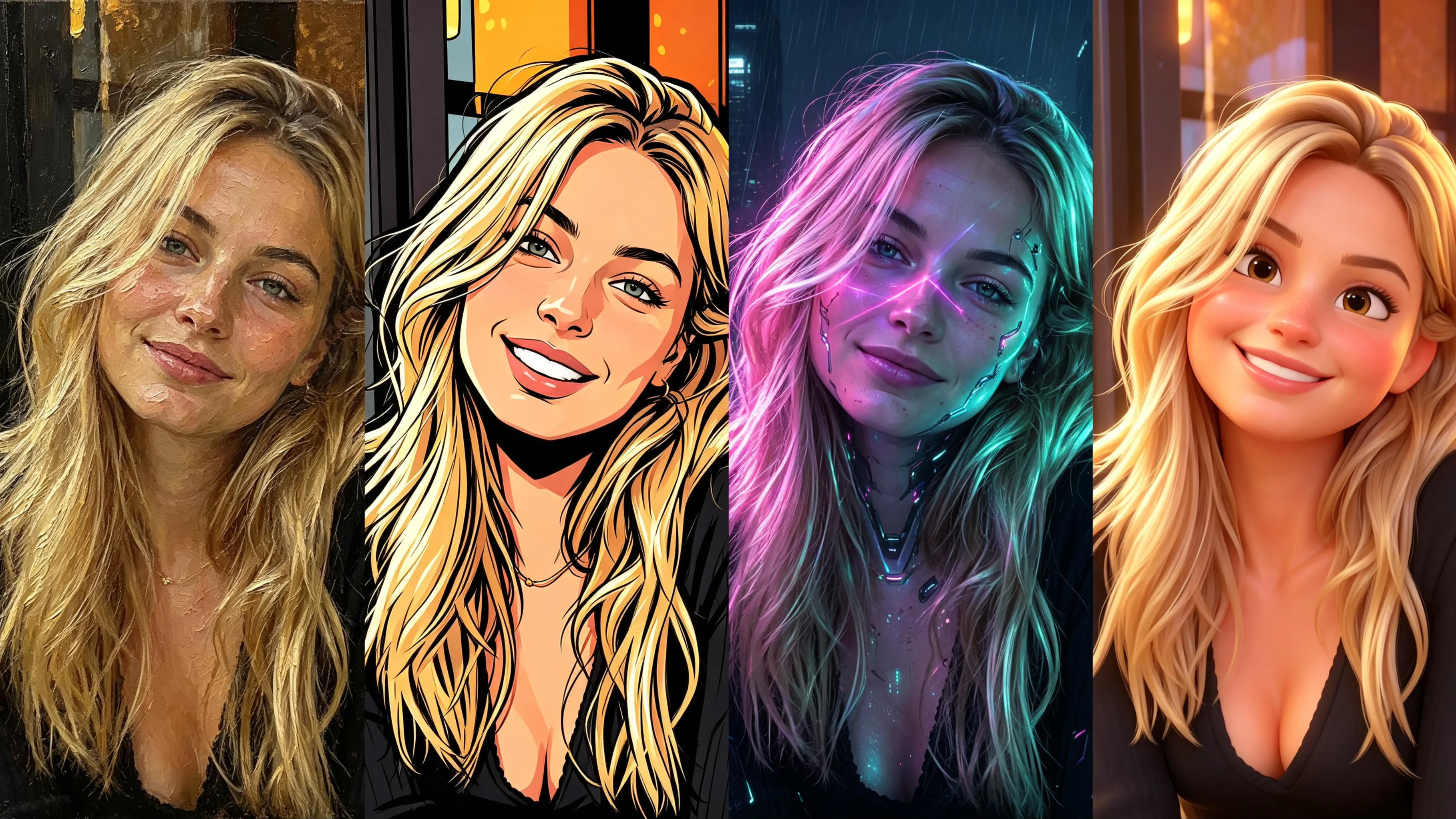
See it in action: One Portrait, Four Looks: the same photo tailored for different platforms.
Choose from 32 styles across 4 categories. The oil painting style for LinkedIn, cyber neon for TikTok, healing illustration for WeChat, and cel-shaded anime for Discord. All from the same photo, all recognizably you, each perfectly adapted to its platform. As a result, you can maintain a cohesive multi-platform identity without any additional photo shoots or editing work.
This is not just convenient — it is a strategic advantage. A creator with a coherent multi-platform visual identity appears more professional, more intentional, and more memorable than someone who uses a random photo on each platform or the same generic headshot everywhere. In an age where digital first impressions are formed in milliseconds, that coherence is a competitive edge.
Case Study: A Creator Avatar Matrix
Consider Maya, a freelance graphic designer and content creator. She needs a professional presence on LinkedIn to attract clients, a creative profile on Instagram to showcase her aesthetic, and a friendly face on WeChat for her personal network. Rather than compromising, she built a cohesive multi-platform identity from a single source photo.
Here is how Maya structured her avatar strategy:
| Platform | Style Chosen | Why This Style | Audience Reaction |
|---|---|---|---|
| Oil painting | Conveys polish and timeless expertise | Clients described her as "professional and approachable" | |
| Watercolor | Artistic, aligns with her creative brand | Followers noted the aesthetic consistency | |
| Healing illustration | Warm, personal, friendly | Friends found it "felt like her" | |
| Discord | Cel shading (anime) | Fun, community-oriented | Gaming community engaged more with her profile |
The result? Maya clients on LinkedIn see a serious professional. Her Instagram followers see a creative artist. Her friends on WeChat see the Maya they know. And her gaming community sees someone who fits right in. One photo, four platforms, four impressions — all authentic, all recognizably Maya.
Your Turn: Start with One Photo
Ready to build your own multi-platform avatar strategy? Follow these four simple steps:
- Start with one good photo. Take a well-lit, front-facing photo with a clean background and a natural expression. This single photo will be the foundation for all your platform avatars, so pick your best one.
- List your platforms. Write down every platform where you have a profile — LinkedIn, Instagram, TikTok, WeChat, Discord, Behance, or any others. Each platform will get its own tailored version.
- Match styles to platforms. For each platform, pick a style that fits its culture. Use the platform guide earlier as your quick reference: LinkedIn → classical, TikTok → bold, WeChat → warm.
- Generate and deploy. Upload your photo to Bobi, generate the styles you have chosen, and update your profiles. The entire process takes just a few minutes for all platforms at once.
Your multi-platform avatar strategy does not need to be complicated. It just needs to be intentional. One photo, multiple styles, a coherent identity across every platform where you show up. Upload your photo and build your personal avatar matrix today.
Frequently Asked Questions
Does using different styles on different platforms weaken my personal brand?
Not if you use the same source photo. The key is that people recognize you across platforms because the underlying face and expression are the same. The style changes, but the person does not. This actually strengthens your brand by showing intentionality and platform awareness.
How often should I update my multi-platform avatars?
There is no fixed rule, but a good practice is to refresh your avatars every 6-12 months, or whenever your look changes significantly. Since Bobi saves your uploaded photo, you can generate new styles anytime without re-taking photos.
Can I use the same photo for LinkedIn and TikTok?
You can, but you probably should not. A style that works on LinkedIn (like oil painting) may feel too formal for TikTok, while a TikTok-optimized style (like cyber neon) may seem unprofessional on LinkedIn. Using the same source photo with different styles gives you the best of both worlds.
What if I use more than four platforms — do I need a different style for each?
Not necessarily. Group platforms with similar cultures. For example, LinkedIn and Xing can share a style. Instagram and TikTok can share another. Focus on the 2-3 platforms that matter most to your personal or professional brand.